Stories Worth Preserving
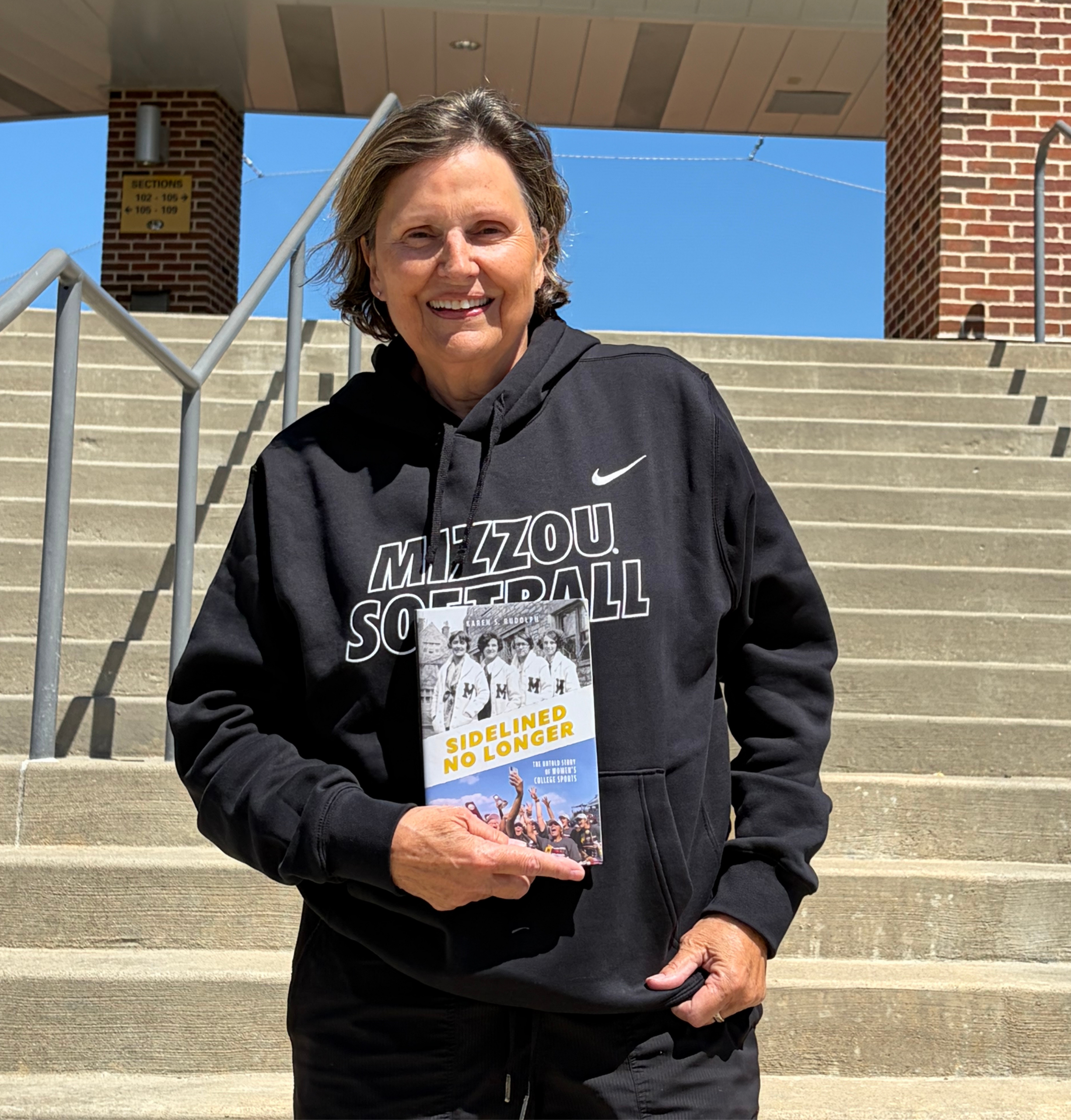
By Karen Rudolph
Author
Picture this: a grade school kid who absolutely loved sports and playground games.
At Minnie Cline Elementary School, a couple of my girlfriends, my twin sister and I, would play flag football with the boys nearly every day at recess. We’d tuck colored bandanas into the tops of our skirts, while the boys tucked theirs into their jeans. After all, skirts, jumpers and dresses were required for girls in the 1960s. Pants and jeans were not allowed. If the weather was hot, we’d slip on shorts under our skirts for modesty.
But we’d play, and we’d play hard.
Beth, Connie, Debbie, Sharon and I had a blast. Our group was every bit as competitive as the boys on the playground. I never thought of what we were doing as unusual, although perhaps our teachers and the physical education instructor did. What mattered was that they made sure we were accepted and had an equal opportunity to play.
Years later, Sharon, Debbie and I played basketball together our senior year of high school, the first time in decades that girls at our Northwest Missouri school had been allowed to participate in interscholastic sports.
You don’t always recognize history when you are living it.
My love of sports began at home. When my dad graduated from high school, he was selected for the Roy Chard Award as the school’s Most Outstanding Athlete. After playing college football at the University of Missouri and serving in the military, he returned to his hometown with my mom, whom he had met on campus, and they raised four kids.
Dad told stories about his teammates and his experiences playing sports. I wanted stories like those for myself.
My mom and dad both taught us how to throw and catch a football, how to use a baseball glove, how to watch an athletic event and how to read a newspaper to learn how our favorite teams had done. By third grade, my reading ability was exceptional, something my dad explained to my teacher was probably a result of reading Sports Illustrated every week.
Each afternoon, I’d wait on the front porch for the newspaper to land on the sidewalk. I’d eagerly read the sports stories and even the statistics buried in the tiny print.
If it makes me sound like a bit of a nerd, well, those stories reveal something about who I was.
My dad also volunteered with the high school athletic program, running the ‘chain gang’ on the sidelines at football games and working the scorer’s table during home basketball games. I often sat there with him, pushing buttons on what was called the “Christmas Tree,” a tower of lights that displayed the number of personal fouls for individual players.
It was an important job for a third grader, and one for which I considered myself highly qualified.
I loved being part of the action.
Then came a moment I’ve never forgotten.
My school had beaten its rival, and everyone crowded toward the locker room to celebrate. I felt as though I had been a part of the victory, so I followed the mob. I was headed into the boys’ locker room when someone grabbed my shoulder and directed me to wait outside.
My younger brother, a little spectator that night, walked right in.
The locker room door closed in my face. I remember the embarrassment and rejection even today. I also remember making a vow: Somehow, I would work toward girls and women being included in sports and competition. If sports were good for boys—and they were—why wouldn’t they be equally good for girls?
I’ve never shared that experience, but it describes accurately my personal motivation to see that girls had opportunities in athletics. I would have to build my own stories.
Today we see girls move from the bleachers to the ballfields and eventually into the boardrooms, making decisions and influencing business, professional sports, education, and countless other parts of American life.
But, how did we get from there to here, and what we see today?
My own experiences eventually taught me the importance of learning, preserving and sharing this history. History is more than what gets recorded. To me, history becomes real when someone cares enough to go looking for it.
And sometimes, a story gets dropped in your lap and begs to be told.
That happened to me in 2022, when I attended a Celebration of Title IX and Women’s Sports at my alma mater, the University of Missouri. One of the featured speakers was Jean Cerra, a former assistant athletic director and director of women’s athletics who helped lead efforts in 1976 to combine men’s and women’s sports into one Department of Intercollegiate Athletics.
As Jean spoke to about 250 people that evening, including members of Missouri’s first women’s teams, I realized how much I didn’t know.
I didn’t know the full story of what Jean and other women athletic administrators had accomplished during the 1970s. I didn’t understand all the obstacles that they faced while building a foundation for women’s sports.
And I wondered: Why didn’t more people know their names, their accomplishments, and their stories?
How did women’s college sports move from governance by an all-women’s organization into a highly competitive and commercialized NCAA (National Collegiate Athletic Association) structure we know today? Who made those decisions? And why?
Jean and I talked afterward. She told me that she needed someone to collect her stories.
I agreed.
A few months later we began work on what eventually became Sidelined No Longer: The Untold Story of Women’s College Sports.
Jean shared her experiences and introduced me to others who shared her passion for ensuring that women athletes received opportunities and benefits comparable to those available to men. She was among a group of 11 women athletic administrators willing to risk their careers and reputations by supporting what was then an unpopular position: working with the NCAA to help advance women’s sports.
That’s where oral history became essential to my work.
An archive can tell you what happened. A person can tell you what it felt like.
The women and men I interviewed could describe what it felt like to challenge a culture, oppose the status quo, sit in difficult meetings and advocate for change when the outcome was anything but certain.
Of course, memories aren’t perfect. People remember events differently. That’s why I compared more than 100 hours of interviews with documents, letters, meeting records and archival materials.
Preserving history requires both listening and verification.
There was also a sense of urgency.
Of the 11 women who founded an organization in 1979 dedicated to advancing and supporting women athletic administrators, an organization of 7,000 members known today as Women Leaders in Sports, six had passed away. I was able to conduct in-depth interviews with the five surviving founders about their pivotal role in implementing Title IX and helping move women’s collegiate sports into the NCAA.
There is a small window in which history can still be told by the people who lived it. The opportunity to record history firsthand doesn’t last forever.
That realization changed the nature of my work.
I was no longer simply writing a book. I was preserving testimony and voices that future generations might otherwise never hear.
Those stories were my stories, too.
I remembered being a little girl dreaming that someday I might have a shiny, flashy basketball uniform when organized sports opportunities for girls were scarce. I remembered as a 16-year-old junior petitioning our local school board to add girls’ basketball. I remembered becoming one of Missouri’s first scholarship women athletes and playing on its first funded women’s basketball and softball teams.
Fifty years later, I was interviewing some of the people who made those opportunities possible.
It had taken me decades to understand that I wasn’t standing outside this history looking in.
I was part of it.
A young athlete today may see packed stadiums, television coverage, scholarships, and professional possibilities and assume that women’s sports have always occupied this kind of space.
They haven’t.
My goal is more than making people nostalgic for a time they never experienced, but helping people understand what the past makes possible.
Knowing these stories gives us something more useful than nostalgia. It gives us perspective.
And perspective creates responsibility.
Every generation inherits something it didn’t build. Every generation also gets to decide what it will build for those who come next.
I wrote Sidelined No Longer because I discovered a story that deserved to survive. The book became a way to preserve the interviews, archives, decisions, disagreements and voices of women whose work helped reshape college athletics. Most importantly, I wanted to connect their experiences with what we see happening in women’s sports today.
Sidelined No Longer: The Untold Story of Women’s College Sports is my effort to preserve one part of that history and put names, voices and stories back into a narrative where they belong.
If you care about where women’s sports have been, how they arrived at this remarkable moment, and what today’s generation can learn from those who came before, I hope you’ll read it.
Because the stories worth preserving become more than memories. They become bridges between the people who built the opportunities, those who inherited them and those who will decide what comes next.